

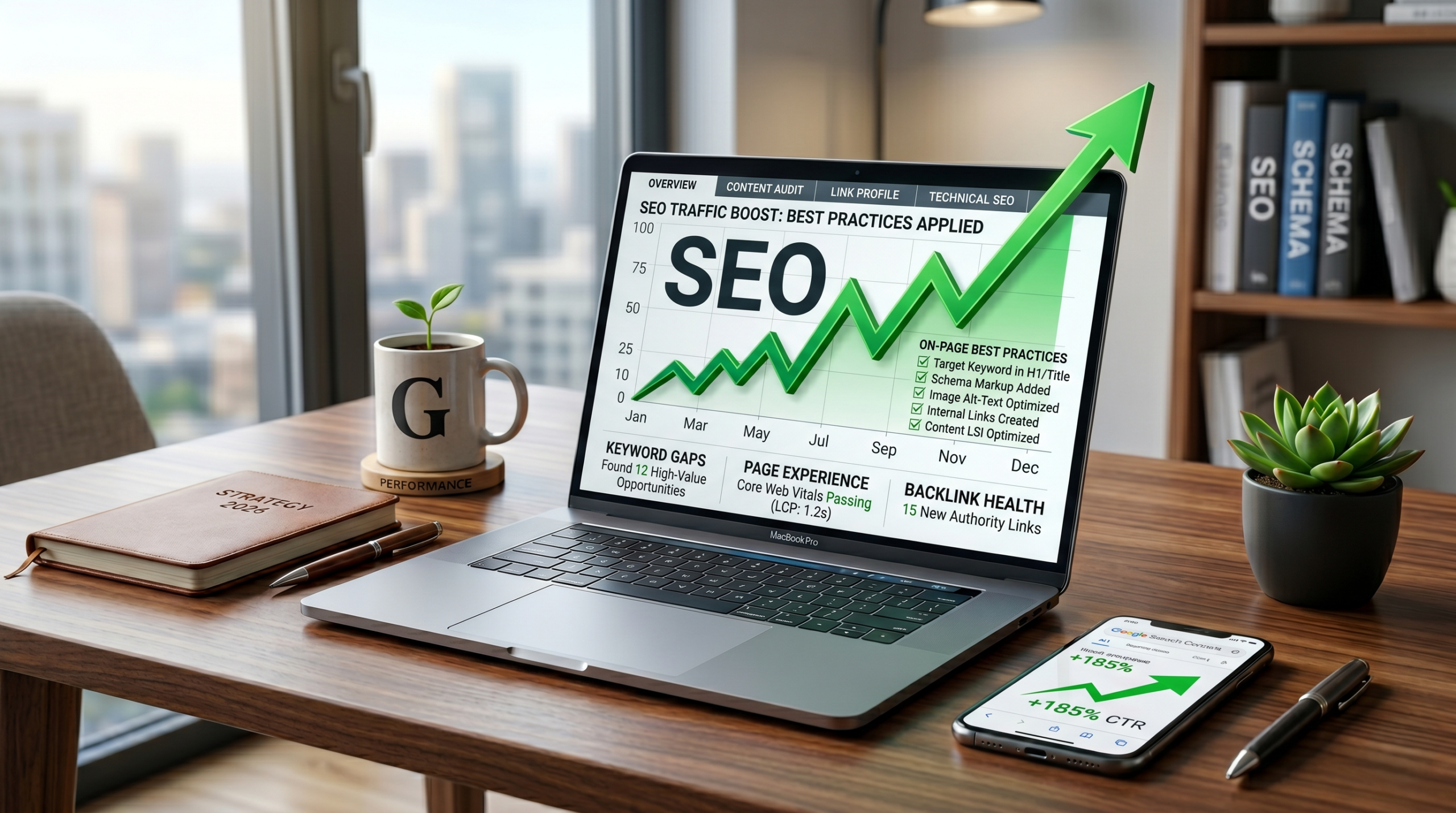

Trying to figure out what are SEO best practices in 2026—and why some websites rank while others stay invisible?
Here’s the reality: SEO is no longer about shortcuts or keyword stuffing. It’s about creating genuinely helpful content, delivering a great user experience, and sending clear credibility signals to search engines.
Related: What is SEO? A Handy Guide to Search Engine Optimization
If you want to rank higher on Google, you need more than keywords—you need a strategy that combines content quality, technical performance, authority, and trust.
In this guide, we’ll break down the SEO best practices that are working right now—plus actionable tips you can apply immediately.
Key Takeaways
- SEO in 2026 focuses on helpful, structured, and trustworthy content
- AI is reshaping how search engines interpret content and intent
- E-E-A-T is not a direct ranking factor but a framework reflected through ranking signals
- Technical SEO and user experience directly impact rankings
- Topical authority is more powerful than isolated keyword targeting
- AEO (Answer Engine Optimization) is essential for AI search and featured snippets
Table of Contents
- What SEO Best Practices Mean in 2026
- Best SEO Practices for Ranking Higher on Google
- AI in SEO and Content Optimization
- On-Page SEO Best Practices
- Google Ranking Factors That Matter Most
- What Is E-E-A-T and Why It Matters for Google Rankings
- Why Ranking Higher on Google Matters for Businesses Online
- Common SEO Mistakes to Avoid
- Final Thoughts on SEO Best Practices for Ranking Higher on Google
- Frequently Asked Questions About SEO Best Practices (How to Rank Higher on Google)
What SEO Best Practices Mean in 2026
What are SEO best practices?
SEO best practices are strategies that improve a website’s visibility by aligning content with search intent, optimizing technical performance, and building authority and trust signals.
Modern SEO prioritizes content that fully satisfies user intent. That means:
- Answering questions clearly
- Providing useful, accurate information
- Matching what users are actually searching for
Emphasis on experience, expertise, and trust (E-E-A-T)
Search engines evaluate content based on credibility signals.
E-E-A-T (Experience, Expertise, Authoritativeness, Trustworthiness) is not a direct ranking factor, but it influences how Google evaluates content quality through measurable signals like accuracy, reputation, and credibility.
Shift toward search experience optimization
SEO now includes:
- Page speed
- Mobile usability
- Content readability
- How easily your content can be extracted by AI systems
Best SEO Practices for Ranking Higher on Google
1. Content quality and search intent alignment
Best SEO practices start with creating content that directly matches what users are searching for. Pages that clearly answer questions and solve problems tend to perform better in search rankings.
Key focus areas:
- Write content that fully answers user intent
- Avoid keyword stuffing and focus on clarity
- Structure content so it is easy to scan and understand
2. On-page SEO optimization
On-page SEO ensures that each page is properly optimized for search engines while remaining user-friendly.
Important elements include:
- Optimized titles and meta descriptions
- Proper use of H1, H2, and H3 headings
- Natural keyword placement in key sections
- Image alt text optimization
Pro tip: Place your primary keyword in the title, first paragraph, and at least one subheading—but keep it natural.
3. Technical SEO and site performance
Technical SEO ensures that search engines can properly crawl, index, and understand your website.
Core practices include:
- Fast loading speed across all devices
- Mobile-friendly and responsive design
- Clean URL structure and site hierarchy
- Proper indexing and sitemap setup
Even a 1-second delay in load time can reduce conversions—speed is both an SEO and business factor.
4. Internal linking and site structure
Internal linking helps connect related pages and strengthens overall website authority.
Best practices include:
- Linking related blog posts and pages
- Using descriptive anchor text
- Creating clear content clusters around topics
5. Authority building and backlinks
Backlinks remain one of the strongest ranking signals in SEO, helping establish trust and authority. High-quality backlinks signal trust—low-quality links can do the opposite.
Focus on:
- Earning links from reputable websites
- Publishing high-value, shareable content
- Building consistent topical authority over time
6. Content updates and freshness
Keeping content updated helps maintain rankings and improve long-term visibility.
Key actions:
- Refresh outdated information regularly
- Update statistics and examples
- Improve existing content based on performance
AI in SEO and Content Optimization
AI-driven search understanding
AI now plays a major role in how search engines interpret content. Instead of relying only on keywords, Google uses systems like BERT and RankBrain to understand meaning and intent more accurately.
Common AI tools used in SEO workflows
AI tools are widely used to improve efficiency in SEO and content creation. Some of the most common include:
- ChatGPT (OpenAI) – content drafting, keyword ideation, and SEO structuring
- Google Gemini – research, AI-assisted search insights, and content generation
- Claude (Anthropic) – long-form writing, editing, and content refinement
- Perplexity AI – AI-powered search with cited answers for faster research
- Jasper AI – marketing copywriting and brand-focused content creation
- Surfer SEO – on-page optimization using SERP and keyword data
- Ahrefs Brand Radar – tracks AI share of voice by measuring how often AI models (e.g., ChatGPT, Perplexity, Gemini) mention your brand vs. competitors
These tools support SEO workflows, but human strategy is still essential for quality and accuracy.
AI Overviews and search evolution
Search engines are increasingly showing AI-generated summaries directly in results. This means content must be:
- Structured clearly
- Easy to extract
- Directly answering user intent
This shift makes AEO (Answer Engine Optimization) more important than ever.
On-Page SEO Best Practices
1. Optimized titles and meta descriptions
Titles should include target keywords naturally and clearly communicate value. Meta descriptions should encourage clicks while summarizing the content.
2. Clear heading structure for readability
Proper use of H1, H2, and H3 tags improves both SEO and user experience by making content easier to scan.
3. Natural keyword placement
Keywords should appear in introductions, headings, and relevant sections without forcing repetition.
4. Internal linking for SEO strength distribution
Internal links connect related pages and help search engines understand your content hierarchy.
Google Ranking Factors That Matter Most
1. Content relevance and search intent alignment
Google prioritizes pages that best match user intent and provide complete answers.
2. Page speed and mobile optimization
Fast, mobile-friendly websites consistently rank higher due to better user experience.
3. Backlink quality and domain authority
Strong backlinks from reputable sources signal trust and improve rankings.
4. User behavior signals
Engagement metrics like time on page and bounce rate help Google evaluate content quality.
What Is E-E-A-T and Why It Matters for Google Rankings
Google’s main goal hasn’t changed: helpful content. But what qualifies as “helpful” is now much more rigorous. In 2026, ranking systems are increasingly aligned with E-E-A-T (Experience, Expertise, Authoritativeness, and Trustworthiness)—not as a direct ranking factor, but as a framework Google uses to evaluate how reliable and credible your content is. It helps determine whether your page deserves to rank higher in search results based on the quality, accuracy, and trustworthiness of the information you provide.
Real experience improves rankings
Content that shows real experience performs better in search.
This includes:
- Personal insights
- Case studies
- Real examples or results
NOTE: Generic content ranks lower compared to content based on actual experience.
Expertise and authority build credibility
Google prefers content from people or brands who clearly understand the topic.
Strong signals include:
- Clear subject knowledge
- Accurate and well-researched information
- Consistent publishing on the same topic
Trust is a major ranking factor
Search engines need to trust your content before ranking it highly.
Trust is built through:
- Clear author identity
- Transparent “About” information
- Reliable and accurate content
Why Ranking Higher on Google Matters for Businesses Online
Business visibility and search presence
Ranking higher on Google allows your business to appear in front of users who are actively searching for your products or services. This increases visibility and helps attract highly relevant traffic without relying heavily on paid ads.
Impact on leads and business growth
Higher search rankings directly influence how many people discover your website. More visibility leads to more inquiries, leads, and conversions, making SEO a key driver of long-term business growth.
Trust, credibility, and brand authority
Websites that appear on the first page of Google are often perceived as more trustworthy. Strong rankings help position your brand as an authority in your industry and increase user confidence in your business.
Common SEO Mistakes to Avoid
Even solid blogs fail because of these:
1. Keyword stuffing
Overusing keywords makes content sound unnatural and can hurt rankings. Google now prioritizes readability and context over repetition.
2. Ignoring mobile optimization
Content that doesn’t match what users are actually looking for will struggle to rank.
- Targeting the wrong type of query
- Not fully answering the user’s question
- Creating content that lacks relevance
3. Thin or low-value content
Content that lacks depth or usefulness fails to satisfy user intent and often leads to lower rankings.
- Shallow or incomplete information
- Lack of real insights or examples
- No clear value for the reader
4. No internal linking strategy
Without internal links, search engines have difficulty understanding your site structure.
- Weak content connections
- Poor navigation
- Missed opportunities to build authority
5. Weak or no backlink strategy
Backlinks remain a strong ranking factor, and ignoring them limits your SEO potential.
- No link-building efforts
- Low-quality backlinks
- Lack of authority signals
6. Lack of E-E-A-T signals
Content without clear credibility struggles to rank in competitive search results.
- No author information
- No proof of experience
- Weak trust signals
Fixing these common SEO mistakes alone can significantly improve your website’s visibility and performance on Google.
Final Thoughts on SEO Best Practices for Ranking Higher on Google
SEO in 2026 is all about creating helpful, well-structured, and trustworthy content that aligns with user intent. When you combine strong content, technical performance, user experience, and authority signals, you build a solid foundation for higher rankings and long-term organic growth.
Frequently Asked Questions About SEO Best Practices (How to Rank Higher on Google)
What are SEO best practices?
SEO best practices are strategies used to improve a website’s visibility on search engines. These include creating helpful content, optimizing for search intent, improving site speed, ensuring mobile-friendliness, and building trust through high-quality links.
How can I rank higher on Google?
To rank higher on Google, focus on publishing high-quality content, optimizing your pages with relevant keywords, improving website speed, and building internal links and authority over time.
What are the most important Google ranking factors?
The most important Google ranking factors include content relevance, search intent, user experience, mobile optimization, page speed, and website authority through backlinks.
What is an SEO checklist for improving rankings?
An effective SEO checklist for improving rankings includes keyword optimization, proper heading structure, fast loading speed, mobile responsiveness, internal linking, and regularly updated content.
How does on-page SEO help improve rankings?
On-page SEO best practices help improve rankings by making your content easier for search engines to understand through optimized titles, headings, keyword placement, internal links, and structured formatting.
Are keywords still important for SEO?
Yes, keywords are still important, but they should be used naturally. Search engines now prioritize context and intent, so overusing keywords can hurt rankings instead of helping.
How long does it take to rank on Google?
Ranking on Google can take anywhere from a few weeks to several months, depending on your competition, content quality, and how well your website follows SEO best practices.
Get professional SEO services in the Philippines to improve your search rankings and boost your online visibility, traffic, and long-term growth. Contact us today for more information.