

What is GEO? A Complete Guide to Generative Engine Optimization


Search is changing. People are no longer relying only on traditional search engines to find information. They are also asking AI tools for recommendations, explanations, comparisons, and direct answers.
This shift has created a new area of digital marketing called generative engine optimization (GEO).
But what exactly is GEO, and how does it differ from traditional SEO?
Key Takeaways: What is Generative Engine Optimization?
- Generative engine optimization (GEO) is the practice of optimizing content for AI-powered search and answer experiences.
- GEO focuses on making information clear, relevant, useful, trustworthy, and easy to understand.
- SEO and GEO work together. GEO does not replace traditional search engine optimization.
- Answering specific, conversational questions can make content more useful for AI search and human readers.
- Strong GEO content should demonstrate expertise, accuracy, experience, and trustworthiness.
- Businesses can start with existing content by improving structure, direct answers, internal links, and topical depth.
- There is no guaranteed formula for AI citations. Focus on creating genuinely valuable content rather than trying to manipulate AI systems.
Table of Contents
- What is GEO?
- Why is Generative Engine Optimization Important?
- How Does GEO Work?
- What is GEO Optimization?
- GEO vs. SEO: What’s the Difference?
- What are the Benefits of GEO for Businesses?
- How Can Businesses Optimize Content for AI Search?
- Does GEO Replace SEO?
- Common GEO Mistakes to Avoid
- Conclusion: Building a Stronger Search Strategy With GEO
- FAQs About Generative Engine Optimization
What is GEO?
Generative engine optimization (GEO) is the practice of creating and improving content so AI-powered search and answer engines can better understand, use, and potentially reference it when responding to users.
The goal is not simply to rank a webpage. It is to make your content useful, clear, trustworthy, and easy for AI systems to interpret when generating responses to users.
Why is Generative Engine Optimization Important?
Generative Engine Optimization is important because user behavior is shifting from keyword-driven search queries to conversational AI prompts. As more searchers rely on direct synthesized answers rather than clicking links, GEO can help your brand improve its chances of being visible within AI-generated responses.
As search behavior continues to change, businesses have a new opportunity to reach their audiences. Their content can potentially be included in an AI-generated answer even when users do not directly visit their website through a traditional search result. As a result, AI search optimization is becoming an increasingly useful part of a broader digital marketing strategy.
GEO can help businesses work toward:
- Greater visibility across AI-powered search experiences
- More opportunities to be referenced or cited in AI-generated answers
- Stronger topical authority
- Better alignment with conversational search queries
- More useful and trustworthy website content
GEO does not mean abandoning SEO. In practice, the two work best together.
How Does GEO Work?
GEO works by organizing content clearly and providing accurate, relevant information that AI search systems can easily understand and use. Clear answers, helpful details, trustworthy sources, and well-structured content can make it easier for AI tools to find and summarize your information.
1. Create Clear, Direct Answers
AI systems need to quickly understand what a page is about and which parts answer a user’s question. Start important sections with a clear, direct answer before adding more details.
For example, give a short definition first, then explain the topic further. This also supports answer engine optimization (AEO) because readers can quickly find the information they need.
2. Answer Specific Questions
Think about the questions your audience is actually asking. A page about GEO, for example, can address questions such as:
- What is GEO?
- What does generative engine optimization mean?
- How does GEO work?
- How is GEO different from SEO?
- Does GEO replace SEO?
- How can businesses optimize content for AI search?
- Why is GEO important for businesses?
Answering these questions directly gives your content more opportunities to match conversational search intent.
3. Build Topical Depth
One article rarely establishes expertise on an entire subject by itself. Instead, create related content that covers different aspects of the topic and connect those pages with relevant internal links. For example, a website discussing digital marketing could publish supporting content about SEO, AEO, AI search, content strategy, search intent, and structured data.
You can connect these articles naturally with descriptive anchor text such as GEO SEO, AI search optimization, or how to optimize content for AI search engines. Doing so helps search engines understand how the topics on your website are related.
4. Use Reliable Sources and Demonstrate Expertise
AI-generated answers are only as useful as the information behind them. Content should be based on accurate information, credible sources, practical experience, and clear explanations. Avoid making unsupported claims simply because they sound authoritative, and provide sources when including statistics, research, industry findings, or technical information.
Businesses can also strengthen their content by showing real experience. Case studies, examples, original insights, expert commentary, and first-hand observations can make a page more valuable and credible than generic information repeated across the web.
What is GEO Optimization?
GEO optimization involves improving website content and structure so AI-powered systems can more easily understand and use the information.
There is no guaranteed checklist for getting cited by a particular AI platform. Still, businesses can take practical steps to make their content more useful for both people and machines.
Write for People First
Keep your content natural and reader-friendly instead of filling paragraphs with keywords. Use clear language, concise explanations, descriptive headings, relevant examples, and smooth transitions to make the content easy to understand.
Organize Information Clearly
Good structure makes a page easier to scan.
Use:
- Descriptive headings
- Short paragraphs
- Bulleted lists when appropriate
- Tables for comparisons
- Definitions for unfamiliar terms
- Direct answers to common questions
This structure can help readers find information quickly while giving search and AI systems clearer contextual signals.
Include Relevant Supporting Details
A strong answer should give enough context to be useful without overcomplicating the topic. Instead of simply defining GEO as “optimizing content for AI,” explain its purpose, how it relates to SEO, which content practices support it, and what businesses can realistically expect.
Keep Content Accurate and Updated
AI search is constantly evolving, so GEO strategies and best practices may change over time. Review your content regularly to update outdated information, correct inaccuracies, and ensure that examples, statistics, and recommendations remain relevant and accurate.
GEO vs. SEO: What’s the Difference?
SEO and GEO have different focuses, but they work closely together. SEO helps websites improve their visibility in traditional search results through factors such as keywords, search intent, technical performance, links, content quality, and site structure.
Related: What is SEO? A Handy Guide to Search Engine Optimization
GEO, on the other hand, focuses on making content clear, relevant, and useful for AI-generated search experiences. Here’s a simple comparison:
| Factor | SEO | GEO |
|---|---|---|
| Primary focus | Improving visibility in traditional search results | Improving visibility in AI-generated search and answers |
| Search environment | Search engine results pages (SERPs) | Generative AI and AI-powered search experiences |
| User queries | Keywords and traditional search queries | Conversational and question-based queries |
| Content approach | Optimizes content for search intent, relevance, and rankings | Creates clear, useful content that AI systems can understand and potentially reference |
| Authority | Builds authority through quality content, backlinks, expertise, and other SEO signals | Builds authority through accurate, relevant, trustworthy, and well-supported information |
| Main goal | Increase organic search visibility and website traffic | Increase visibility and potential inclusion in AI-generated answers |
| Relationship | Established search optimization practice | Complements SEO as search evolves |
What are the Benefits of GEO for Businesses?
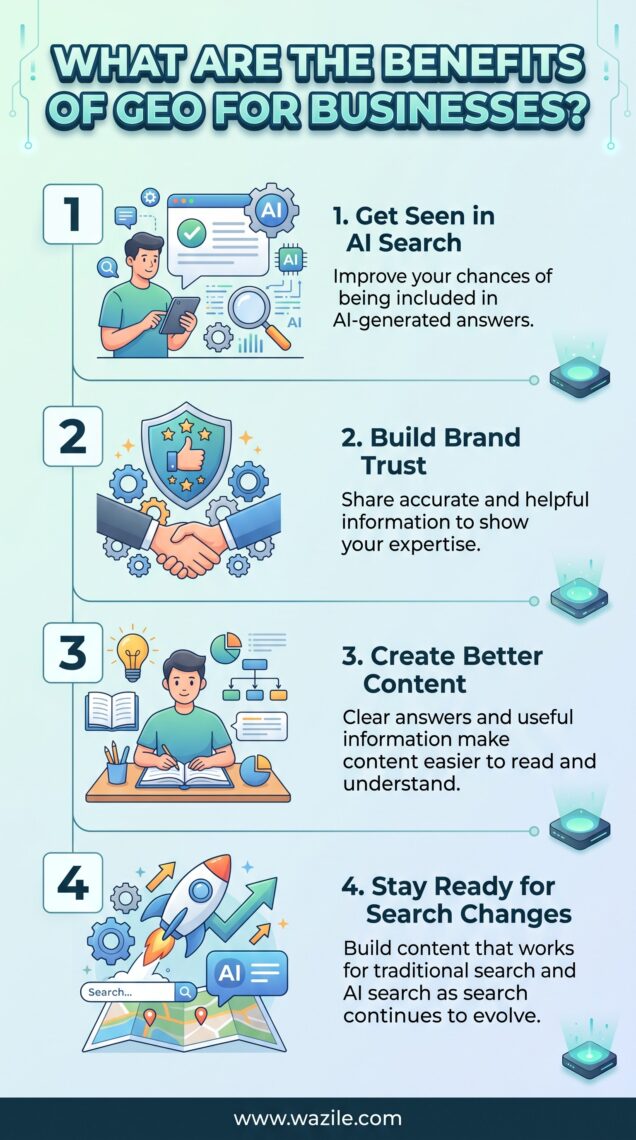
The primary benefit of GEO for businesses is sustained visibility and authority in an AI-first search landscape. When brands adapt their content for generative engines, they can improve their chances of gaining visibility in AI-generated answers, attracting relevant traffic, and strengthening their topical authority.
Potential benefits include:
Greater AI Search Visibility
Useful, relevant content has a better chance of being considered when AI systems retrieve information for an answer.
Stronger Brand Authority
Consistently publishing accurate and useful information can help establish a business as a knowledgeable source within its field.
Better Content for Users
Many GEO-friendly practices also improve the reader experience. Clear answers, useful examples, logical organization, and concise explanations make content easier to consume.
Support for Long-Term Search Strategy
Search behavior continues to evolve. Building a strong content foundation that works across traditional search and AI-driven experiences can help businesses adapt as search changes.
How Can Businesses Optimize Content for AI Search?
Businesses can start with the same foundation used for good content marketing: understand their audience, identify the questions they ask, and provide genuinely useful answers. Instead of creating a completely separate strategy for AI search, businesses can improve existing content and apply GEO principles across their website.
Identify Conversational Search Queries
Think beyond short keywords and consider the complete questions customers might ask before making a decision. For example, a business offering professional services could address questions such as:
- What does this service include?
- How much does this service cost?
- Who needs this service?
- What should I look for in a provider?
- How long does the process take?
- What are the common mistakes to avoid?
These questions can become blog topics, FAQ sections, service-page content, or supporting sections within existing pages. Answering them clearly can also make your content more useful for people using conversational AI search.
Strengthen Your Existing Content
GEO does not mean creating hundreds of new articles. Start by reviewing pages that already receive traffic or address important customer questions. Look for simple ways to make them more useful, such as:
- Adding clearer definitions
- Answering common questions earlier
- Removing unnecessary filler
- Adding relevant examples
- Improving headings
- Strengthening internal links
- Including credible supporting sources
- Updating outdated information
These improvements can strengthen the overall quality and usefulness of a page while supporting your existing SEO efforts.
Use Specific Internal Links
Internal links help users and search systems understand how different topics on your website relate to one another. Instead of generic anchors such as “click here,” use descriptive phrases that clearly indicate what the linked page is about.
For example, an article about GEO could naturally link to generative engine optimization services, AI search optimization, SEO services in the Philippines, or GEO vs SEO. The anchor text should accurately describe the page being linked to. There is no need to force an exact-match phrase if it makes the sentence awkward.
Does GEO Replace SEO?
No. GEO does not replace SEO. SEO remains important for helping search engines discover, crawl, understand, and rank web pages. Technical SEO, on-page optimization, internal linking, site structure, and high-quality content continue to play an important role in search visibility.
GEO expands the focus by considering how content can be surfaced and used in generative search experiences. Rather than competing with SEO, GEO works alongside it. A strong digital strategy can combine SEO, GEO, and AEO to make content more accessible across different search and answer experiences.
Common GEO Mistakes to Avoid
GEO is still a developing field, and there is plenty of misleading advice online. Avoid strategies that promise guaranteed AI citations or visibility.
Keyword Stuffing
Keyword stuffing is when you keep repeating the same term in every sentence or paragraph, forcing the keyword into the content just to use it more often. For example, repeatedly using “GEO” or “generative engine optimization” throughout an article can make the content sound unnatural and difficult to read.
Writing Only for AI
Content should always be written for people first. If an article is difficult to read, overly repetitive, or filled with unnatural keyword variations, trying to optimize it for AI can make the content less useful and engaging.
Making Unsupported Claims
Avoid claiming that any specific tactic can guarantee an AI citation or ranking, since AI search platforms are complex and their systems can change over time. Instead, focus on creating content that is clear, relevant, accurate, and trustworthy.
Ignoring Traditional SEO
GEO should not be treated as a reason to overlook technical SEO or basic website quality. A strong SEO foundation still matters, so make sure your website is fast, mobile-friendly, easy to navigate, properly structured, and accessible to search engines. These fundamentals support your SEO efforts while also helping your content perform well in AI-powered search experiences.
Conclusion: Building a Stronger Search Strategy With GEO
Generative engine optimization is part of a broader shift in how people find and consume information online. The goal isn’t to create content solely for AI systems, but to provide information that is clear, relevant, useful, and trustworthy for both readers and search technologies. For businesses, this means answering real questions, demonstrating genuine expertise, organizing information clearly, and keeping content accurate and useful over time.
When combined with traditional SEO and AEO, GEO optimization can become part of a well-rounded search strategy. This helps businesses strengthen their online presence while adapting to the way search continues to evolve.
FAQs About Generative Engine Optimization
What is generative engine optimization?
Generative engine optimization is the practice of creating and optimizing content so AI-powered search and answer engines can better understand, retrieve, reference, and potentially cite it when responding to user queries.
What is GEO in digital marketing?
GEO refers to Generative Engine Optimization in digital marketing. It focuses on improving a brand’s content for AI-driven search experiences while working alongside established SEO and content marketing practices.
What is the difference between GEO and SEO?
SEO focuses primarily on improving visibility in traditional search engine results, while GEO considers how content can be discovered and used in AI-generated answers. The two overlap and can be used together.
How do I optimize my content for AI search?
Start by answering relevant questions directly, using clear content structures, providing accurate information, demonstrating expertise, building topical depth, and connecting related pages with useful internal links.
Does GEO replace SEO?
No. GEO complements SEO rather than replacing it. Traditional SEO remains important for website visibility, while GEO addresses the growing role of AI-powered search and answer experiences.
Can GEO guarantee that my website will appear in AI answers?
No. There is no guaranteed method for getting a website cited or mentioned by a specific AI search platform. The best approach is to create accurate, relevant, well-structured content that genuinely answers users’ questions.
Why is generative engine optimization important for businesses?
Generative engine optimization is important because more people are using AI tools to research products, services, and topics. GEO helps businesses create clear, useful, and trustworthy content that can be considered for AI-generated answers while also supporting their broader SEO and content strategy.
Ready to improve your AI search visibility? Explore generative engine optimization services in the Philippines and build a stronger presence across AI-powered search experiences. Get started today!