




Alt text: Person working at a desk looking at a monitor displaying the letters AEO magnified through a glass lens.
If you’ve been hearing more about AI search, Google’s AI features, and platforms that provide direct answers instead of a list of links, you may be wondering: what is AEO?
AEO stands for Answer Engine Optimization. It is the practice of creating and structuring content so answer engines can understand it, identify useful information, and potentially use it when responding to users’ questions.
Traditional SEO still matters, but search is changing. People are increasingly asking complete questions and expecting quick, direct answers. AEO helps businesses adapt their content to this behavior by focusing on clear answers, useful context, and information that is easy for both people and search systems to understand.
Key Takeaways: What Is AEO?
- AEO stands for Answer Engine Optimization. It focuses on creating and structuring content so answer-focused search experiences can understand and surface useful information.
- AEO prioritizes clear, direct answers. Answer the main question early, then provide supporting details, examples, and context.
- Search intent matters. Identify what users are actually asking and create content that addresses their questions rather than simply repeating keywords.
- Clear structure makes information easier to understand. Descriptive headings, short paragraphs, definitions, tables, and step-by-step explanations can help readers find important information quickly.
- Related questions can strengthen content coverage. Address relevant follow-up questions to provide a more complete resource and support different stages of the user’s search journey.
- Reliable sources support content quality. Use trustworthy references when making factual or data-driven claims, and keep important information updated.
- AEO works alongside SEO. SEO remains important for search visibility, while AEO adds greater focus on direct answers and answer-focused search experiences.
- Good AEO starts with useful content. The goal is not to write for search engines alone, but to create accurate, helpful, easy-to-understand information that answers real user questions.
Table of Contents
- What Is AEO?
- Why Is AEO Important?
- How Does AEO Work?
- AEO vs. SEO: What’s the Difference?
- AEO and GEO: How Are They Related?
- How to Optimize Content for AEO
- What Are the Benefits of AEO?
- Does AEO Replace SEO?
- Common AEO Mistakes
- How to Build an AEO-Friendly Content Strategy
- Conclusion: What Is AEO and Why Does It Matter?
- Frequently Asked Questions About AEO
What Is AEO?
Answer Engine Optimization (AEO) is the process of optimizing content to increase its chances of being understood, surfaced, or referenced by answer-focused search experiences. Instead of focusing only on ranking a webpage for a keyword, AEO considers the questions people ask and how those questions can be answered clearly within your content.
For example, someone might search, “What is the difference between SEO and AEO?” A traditional SEO approach might focus on ranking for that phrase, while an AEO-focused approach would also make sure the page provides a concise, direct explanation that can easily be identified as an answer.
This means AEO places emphasis on:
- Answering specific questions clearly
- Providing direct information near the beginning of a page
- Organizing content with descriptive headings
- Using natural, conversational language
- Supporting claims with reliable information
- Covering related questions and topics
- Making content easy to scan and understand
AEO Meaning in Simple Terms
The simplest AEO meaning is this: AEO helps your content provide clear answers that search engines and AI-powered answer systems can understand and use.
Think of it as making your content easier to interpret, not just easier to rank.
Why Is AEO Important?
Search behavior has become more conversational and specific. Instead of using only short keyword phrases, people often ask complete questions when they want explanations, comparisons, recommendations, or step-by-step guidance. This means content needs to address the actual questions behind a search, not just include the words someone might type into a search bar.
At the same time, search platforms are increasingly presenting direct answers and summaries alongside traditional search results. AI-powered search experiences may draw information from multiple sources to give users a more complete response.
For businesses, this means creating content that is useful beyond traditional rankings. Information needs to be clear, well-structured, and relevant enough for answer engines to understand the topic and connect useful information to a user’s question. This is where AEO can complement traditional SEO.
How Does AEO Work?
So, how AEO works comes down to making information easier to find, interpret, and extract from your content.
There is no single formula that guarantees an answer engine will select a particular webpage. However, several practices can make content more useful for answer-focused search experiences.
1. Start With the User’s Question
AEO begins with understanding what your audience actually wants to know. Instead of creating an article around a broad keyword alone, consider the questions behind the search and the information someone expects to find when they use that query. The same keyword can represent different intentions, so understanding the user’s goal helps you decide what information should appear first and what supporting details the content should include.
Look at the questions your audience asks in search results, FAQs, customer conversations, forums, and other relevant sources. For example, people searching for information about AEO may have different goals. One person may want a basic definition, while another may be looking for practical ways to apply it or understand how it fits into their existing SEO strategy. Identifying these different search intents helps you create content that answers the specific questions readers are trying to solve instead of repeating the same keyword throughout the page.
2. Give a Direct Answer Early
One of the simplest ways to make content more AEO-friendly is to answer the main question near the beginning. If someone lands on an article about AEO, they should be able to understand what it means without having to read through the entire page first. After giving the direct answer, you can provide additional context, examples, and supporting details. This answer-first structure helps readers quickly find what they need while still giving them the option to explore the topic further.
3. Use Clear Headings and Subheadings
Well-organized content is easier to scan, understand, and navigate. Use descriptive H2s and H3s that clearly communicate the question or topic covered in each section. Instead of vague headings such as “More Information” or “Additional Details,” use specific headings that tell readers what they will find, such as “How Does AEO Work?” or “What Is the Difference Between SEO and AEO?”
Clear headings also help break a larger topic into logical sections and show how different pieces of information relate to one another. When each heading accurately reflects the content that follows, readers can quickly identify the sections most relevant to their questions. This clear structure can also help search and answer systems better understand the purpose and context of different sections on a page.
4. Write in a Natural, Conversational Style
People rarely phrase questions exactly like keywords in a search tool. They may type or speak complete questions instead, such as, “How can I optimize my website for AI search?” rather than simply searching for “AEO techniques.”
Writing naturally allows your content to address these variations without forcing keywords into every paragraph. This is particularly useful for content designed to work across traditional search and AI-driven search experiences.
5. Cover Related Questions
A strong AEO article should not answer one question and stop there. Once you identify the primary search intent, think about what the reader is likely to ask next. Someone researching AEO may also want to understand how it differs from SEO, how answer engines interpret webpages, whether it replaces traditional SEO, or how to improve content for AI-powered search.
Addressing relevant follow-up questions can make your content more useful and provide a more complete explanation of the topic. Instead of creating separate pages for every closely related question, you can answer the most relevant ones within the same article when they naturally fit the user’s search journey.
The key is to focus on relevance rather than adding questions simply to make the article longer. Cover the follow-up topics that genuinely help readers understand the subject, and organize them under clear headings so they can easily find the information they need.
AEO vs. SEO: What’s the Difference?
SEO and AEO overlap, but they focus on different aspects of search visibility. SEO aims to improve a website’s visibility in search results, while AEO focuses on making information clear and useful for answer-focused search experiences.
Related: What is SEO? A Handy Guide to Search Engine Optimization
| Factor | AEO | SEO |
|---|---|---|
| Primary focus | Providing direct, useful answers | Improving search engine visibility |
| Search intent | Centers on questions and answer-focused intent | Targets keywords and broader search intent |
| Content approach | Makes information easy to understand, extract, and surface | Optimizes content for relevance, rankings, and organic traffic |
| Key practices | Direct answers, clear headings, concise explanations, structured content | Keyword research, technical optimization, internal linking, and link building |
| Search experience | AI-powered search and answer-focused experiences | Traditional search results |
| Success measures | Visibility in answer-focused experiences, qualified traffic, engagement, and conversions | Rankings, organic traffic, clicks, and conversions |
The two approaches work well together. A well-optimized article can target relevant search terms, use a logical page structure, earn authoritative links, and provide direct answers to common questions. These elements can support both traditional search visibility and answer-oriented discovery.
AEO should be viewed as a complement to SEO, not a replacement for it. Strong content can combine SEO fundamentals with clear, answer-focused information to serve users across different search experiences.
AEO and GEO: How Are They Related?
AEO and GEO are closely related because both focus on making content easier for AI-powered search experiences to understand and use. The main difference is in their emphasis. AEO focuses on providing clear, direct answers to user questions, while GEO takes a broader approach to optimizing content for generative AI search experiences.
GEO, or Generative Engine Optimization, is a developing approach that considers how content can be understood, retrieved, summarized, and potentially referenced by generative AI systems. AEO can support this goal by organizing information around real questions, providing direct answers, using clear headings, and giving enough context for AI systems to understand the topic.
Related: What is GEO? A Complete Guide to Generative Engine Optimization
The two approaches should not be treated as completely separate or standardized disciplines. Their definitions and practices continue to evolve as search and generative AI technologies change. In practice, businesses can use AEO as part of a broader GEO and SEO strategy: SEO helps content remain discoverable in search, AEO helps make answers clear and accessible, and GEO considers how that content can work within generative AI search experiences.
The goal across all three is similar: create accurate, useful, well-structured content that serves real user needs rather than content designed only to manipulate search systems.
How to Optimize Content for AEO
Creating AEO-friendly content does not require completely changing your existing content strategy. Many AEO practices overlap with good SEO and content-writing principles.
1. Identify Question-Based Search Intent
Start by thinking about what your audience actually wants to know. Search intent simply means the reason behind someone’s search, or what they are hoping to find when they type a question into a search engine. Instead of focusing only on a broad keyword, think about the question behind the search and the type of answer the person needs. This helps you create content that addresses a real need instead of simply repeating keywords throughout the page.
For example, someone searching “AEO meaning” probably wants a simple explanation of what AEO is. Someone searching “AEO examples” may want to see how AEO works in real situations, while a person searching “AEO vs SEO” is likely trying to understand how the two approaches differ. Someone searching “how to improve AEO for my website” is looking for practical steps they can follow.
These searches are all related to AEO, but each person is looking for something different. Understanding what the searcher wants helps you decide what to explain, how much detail to provide, and what information should appear first in your content.
2. Use an Inverted-Pyramid Approach
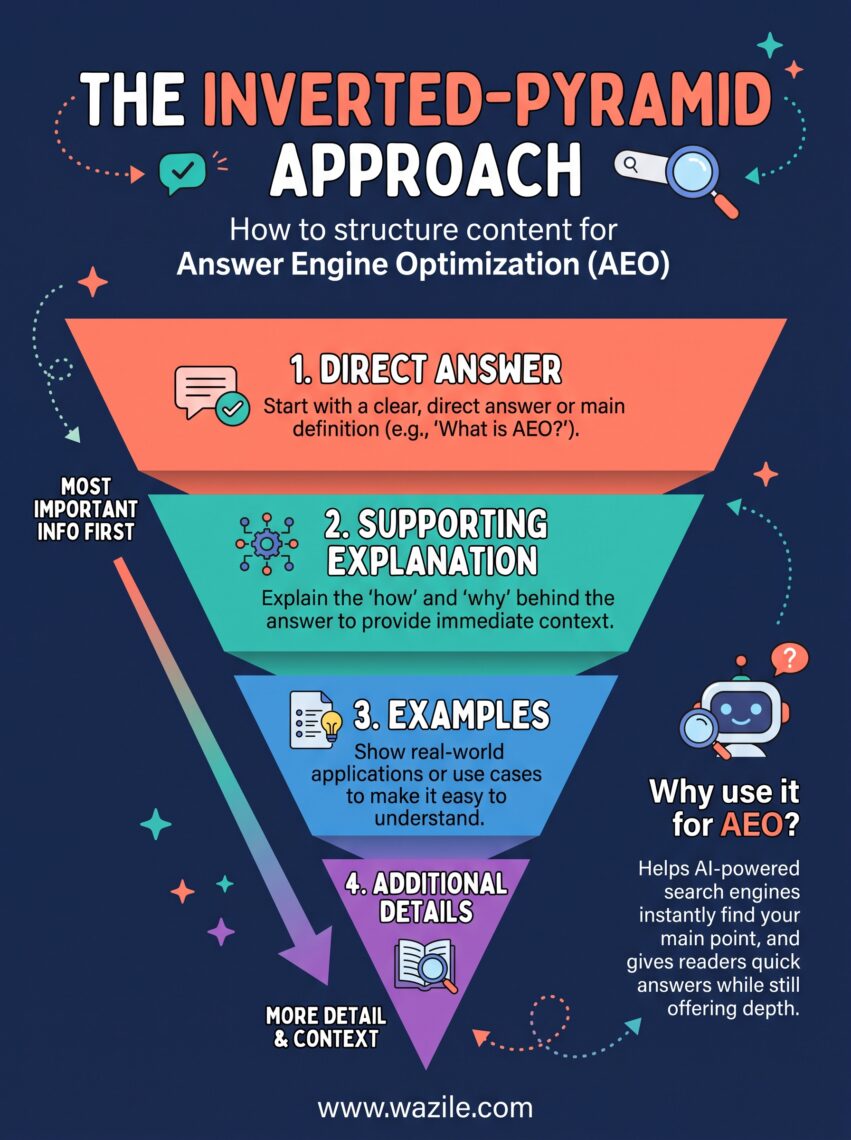
Alt text: An infographic explaining the inverted pyramid approach for AEO, prioritizing direct answers over deep details.
The inverted-pyramid approach means putting the most important information first, then following it with supporting details. In other words, start with the answer or main takeaway before expanding on the topic. This is especially useful for AEO because readers can quickly find the information they need, while answer-focused systems can more easily identify the main point of a section.
A simple structure to follow is:
Direct answer → supporting explanation → examples → additional details
If you’re answering a question such as “How can I optimize content for AEO?”, start with the most useful recommendation before expanding on the reasoning, examples, and supporting details. This keeps the content useful for readers who want a quick answer while still providing enough depth for those who want to learn more.
3. Make Important Information Easy to Extract
Make the main answer easy to find. Avoid hiding important information inside long paragraphs or making readers go through unnecessary details before getting to the point.
A simple structure is:
- Main answer: Give the direct response to the question.
- Explanation: Add context that helps the reader understand the answer.
- Examples: Show how the concept works in a real situation.
- Supporting details: Provide additional information for readers who want to explore the topic further.
Use clear headings, short paragraphs, definitions, tables, and step-by-step explanations to organize the information and make the page easier to scan.
The goal is not to remove useful context or make every answer as short as possible. Instead, give readers the key information first, then provide the details they need to understand the topic more fully. This clear structure can also make important information easier for search and answer systems to identify and interpret.
4. Support Claims With Reliable Sources
Trust matters when creating content for search and answer experiences. When making factual or data-driven claims, use reliable sources and link to relevant supporting information where appropriate. Depending on the topic, useful sources may include government agencies, recognized organizations, academic institutions, industry publications, or official company documentation.
Reliable sourcing helps support factual claims and gives readers a way to verify important information. Citing trustworthy sources can also provide additional context for claims that may require more explanation.
5. Keep Content Updated
Information can change over time, especially in areas involving technology, search, regulations, products, and industry practices, so review important content periodically to make sure statistics, examples, links, and recommendations remain accurate and useful for readers.
When reviewing existing content, check:
- Statistics and data: Are the numbers still accurate and supported by reliable sources?
- Examples: Do the examples still reflect current practices or situations?
- Links: Are all internal and external links working and pointing to relevant pages?
- Recommendations: Are the tools, products, or strategies still appropriate?
- Outdated information: Have any facts, terminology, or industry practices changed?
- Search intent: Does the content still answer the questions users are searching for?
What Are the Benefits of AEO?
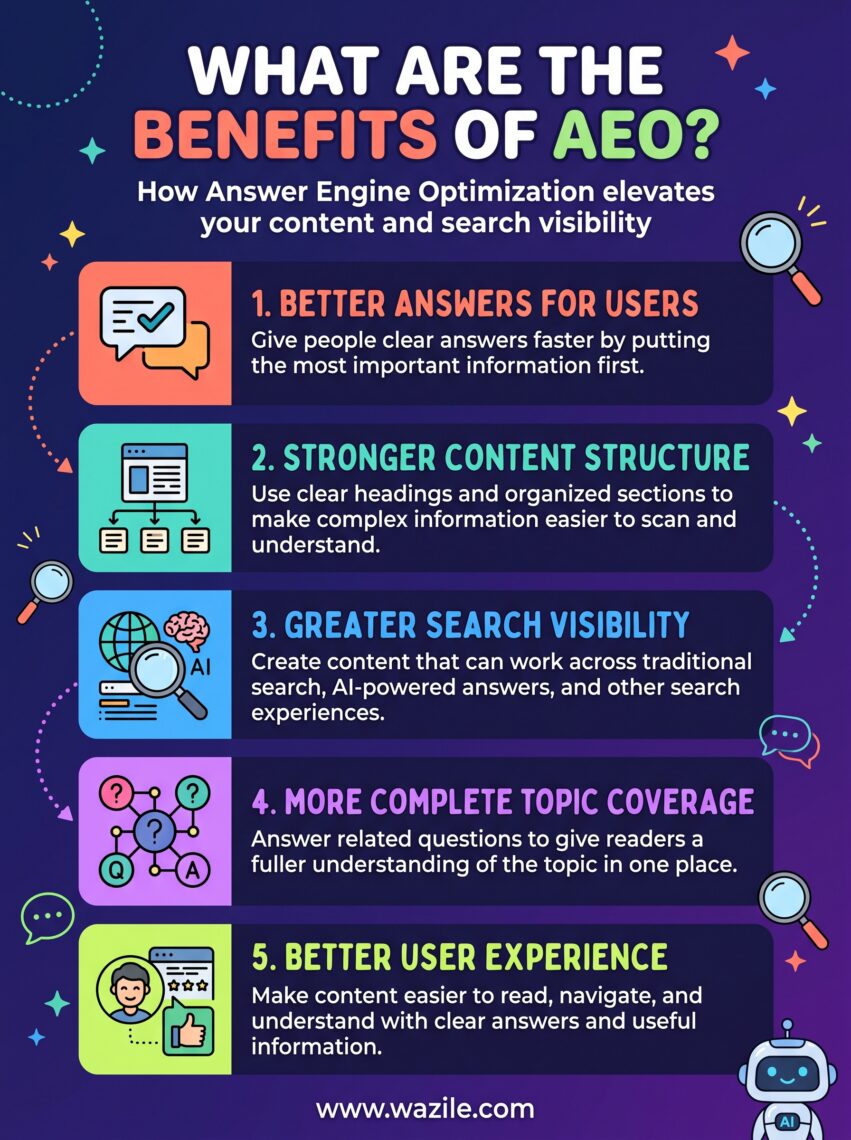
Alt text: Infographic listing the key benefits of AEO (Answer Engine Optimization)
AEO can provide several potential benefits when incorporated into a broader content strategy. By focusing on clear answers, useful structure, and real user questions, businesses can make their content more helpful while improving how information can be understood across different search experiences.
Better Answers for Users
AEO puts greater emphasis on answering the user’s main question clearly and early. Instead of making readers search through long paragraphs to find a specific piece of information, the content provides a direct response before expanding with additional context, examples, or explanations. This can make the overall experience faster and easier to navigate.
Stronger Content Structure
Organizing content around questions naturally encourages a logical structure. Clear headings, concise explanations, lists, tables, and supporting details can help break complex topics into smaller sections that are easier to understand. A well-structured page also makes it easier for readers to scan and find the information most relevant to them.
Greater Visibility Across Search Experiences
Search is no longer limited to a traditional list of blue links. Users may encounter featured answers, AI-generated summaries, voice search responses, and other answer-focused experiences. Content that clearly addresses relevant questions and presents information in an understandable format can be better suited to these different ways of finding information.
More Complete Topic Coverage
AEO encourages businesses to look beyond one primary question and consider the related questions users may have. For example, someone researching AEO may also want to know how it works, how it differs from SEO, and what practical steps they can take to improve their content. Addressing these related questions can create more comprehensive content and help guide readers through different stages of their research.
Better User Experience
Clear answers, descriptive headings, concise sections, and useful supporting information can make content easier to read and navigate. When visitors can quickly understand a topic and find answers to their questions, they are more likely to have a positive experience with the page. AEO therefore supports not only search visibility but also the overall usefulness of the content.
Does AEO Replace SEO?
No. AEO does not replace SEO. The two approaches focus on different aspects of search, but they can work together as part of a broader content strategy.
SEO remains important for keyword targeting, technical performance, website structure, internal linking, backlinks, and organic search visibility. AEO adds greater emphasis on direct answers, conversational questions, clear content structure, and answer-focused search experiences.
Rather than choosing one approach over the other, businesses can combine SEO and AEO to create content that is easier to find, understand, and use across traditional search results and newer answer-focused experiences.
Common AEO Mistakes
AEO is not just about adding questions to a page or formatting content in a certain way. The way information is written and organized still matters. Avoiding these common mistakes can help you create content that is useful to readers while remaining easy for answer engines to understand.
Keyword Stuffing
Repeating the same keyword throughout a page does not automatically make content more optimized. Excessive keyword use can make sentences sound unnatural and may distract from the information the reader is looking for.
Use your primary keyword where it makes sense, but allow related terms and natural language to appear throughout the content. The focus should remain on answering the user’s question clearly rather than trying to repeat a specific phrase as often as possible.
Giving Vague Answers
A page can contain plenty of information and still fail to answer the user’s question clearly. Long introductions, general statements, or answers that avoid getting to the point can make it difficult for readers to find the information they need.
Start with a clear and direct answer, then use the rest of the section to explain the topic in more detail. This gives readers an immediate response while still allowing you to provide useful context and examples.
Writing Only for Search Engines
Content created primarily to satisfy search systems can quickly become repetitive, awkward, or difficult to read. Adding unnecessary sections, forcing keywords into sentences, or writing in an overly formulaic way can take attention away from the user’s actual needs.
Write for people first. Use natural language, explain concepts clearly, and include information because it helps the reader understand the topic, not simply because it creates another opportunity to use a keyword.
Ignoring Search Intent
Using the right keyword does not guarantee that a page answers the right question. A search term can reflect different goals depending on what the user is trying to accomplish, and content that misses that intent may not provide a useful answer.
Consider what the user expects to find when they search. Someone looking for “AEO techniques” may want practical ways to improve their content, while someone searching for “AEO vs SEO” is likely comparing the two approaches. Matching the content to that intent makes the answer more relevant and useful.
Overlooking Content Quality
AEO is not simply about formatting information so it can be easily extracted. The content itself still needs to be accurate, relevant, useful, and supported by reliable information.
Provide clear explanations, use trustworthy sources when making factual claims, and make sure the information reflects the topic accurately. Good structure can make quality content easier to understand, but it cannot make weak or inaccurate information valuable.
How to Build an AEO-Friendly Content Strategy
AEO works best as part of a broader content strategy rather than as a standalone tactic. Start by identifying the questions your audience asks at different stages of their customer journey, then organize those questions into content topics that address their needs.
Build Foundational Content
At the beginning of the customer journey, people may have limited knowledge of a topic and need simple, introductory information. Create content that explains key concepts, definitions, and basic questions in a clear and accessible way. This gives readers a starting point and helps establish your website as a useful source of information.
Related: What is Content Marketing? A Simple Guide
Create Comparison and Educational Content
Once readers understand the basics, they may start researching different approaches, solutions, or options. Content at this stage can answer comparison questions, explain differences between related concepts, and provide more detailed information to help readers evaluate what they have learned.
Develop In-Depth Guides
Some users will want to go beyond basic explanations and understand how something works. Detailed guides, tutorials, and educational articles can address these deeper questions while providing examples, context, and supporting information. This type of content can also connect related topics and strengthen your coverage of a subject.
Provide Practical, Actionable Content
When readers are ready to take action, they are likely looking for specific steps they can follow. Create content that provides practical advice, processes, examples, checklists, or recommendations that help users apply what they have learned.
Address Decision-Making Questions
Before taking the next step, readers may want to understand the potential benefits, limitations, costs, or value of a solution. Content that addresses these decision-making questions can help users evaluate their options and make more informed choices.
This approach can help create a connected content library that supports users throughout their search journey while building deeper coverage around important topics. Internal linking can then connect related pages, helping readers move naturally from introductory information to more detailed guidance and actionable content.
Conclusion: What Is AEO and Why Does It Matter?
AEO, or Answer Engine Optimization, focuses on creating content that clearly addresses users’ questions and makes important information easier for answer engines to understand and surface. As search becomes more conversational and answer-focused, businesses can strengthen their content by providing direct answers, clear structure, useful context, reliable information, and content that matches search intent.
That does not mean traditional SEO is no longer important. Both approaches can work together to create content that is useful to readers and accessible across different search experiences. The strongest approach is not to write for search engines alone, but to make your content genuinely helpful, easy to understand, and easy to find. When you consistently answer real questions with clear and useful information, you give both your audience and search systems a better reason to trust and use your content.
Frequently Asked Questions About AEO
How do answer engines understand website content?
Answer engines use signals from website content to identify relevant information, understand its context, and determine how well it addresses a user’s query. Clear headings, well-structured content, direct answers, relevant supporting information, and trustworthy sources can make content easier for these systems to interpret.
What types of content can benefit from AEO?
Many types of content can benefit from AEO, including blog posts, guides, FAQs, product and service pages, comparison pages, and other resources that address specific user questions. Content is more likely to benefit when it provides clear, useful information that matches what people are searching for.
Does AEO require a separate content strategy?
Not necessarily. AEO can be incorporated into an existing SEO and content strategy. You can adapt your current approach by identifying question-based search intent, providing direct answers, improving content structure, and covering relevant follow-up questions.
How can I make my content AEO-friendly?
Start by identifying the questions your audience is asking and answering the main question clearly and early. Use descriptive headings, organize information logically, address relevant follow-up questions, write naturally, and support important claims with trustworthy sources. Strong SEO fundamentals should remain part of the process.
Is AEO the same as SEO?
No. SEO is a broader approach to improving a website’s visibility and performance in search, while AEO focuses more specifically on creating content that clearly answers questions and works well within answer-focused search experiences. The two approaches can work together as part of the same strategy.
Looking to grow your business online? Partner with a trusted digital marketing agency in the Philippines for digital strategies tailored to your goals.