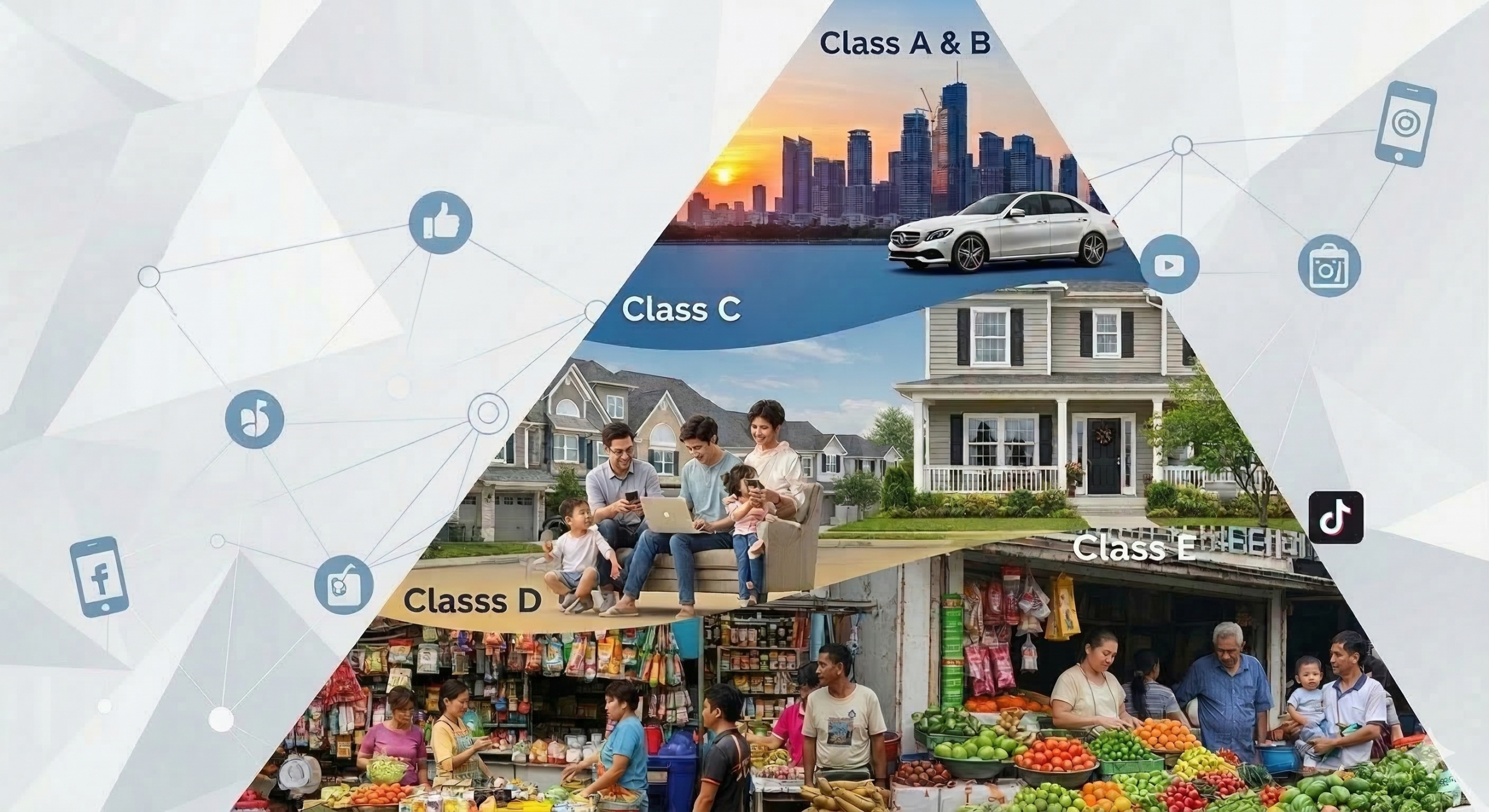
The Philippines is one of Southeast Asia’s most dynamic consumer markets — but also one of its most unequal. Filipino consumers don’t behave as one homogenous group. The Class A executive in Bonifacio Global City who shops at Rustan’s lives in an entirely different reality from the Class D tindahan owner in Cebu who tops up her GCash every payday.
Getting this distinction right is the difference between a campaign that resonates and one that burns budget. This guide breaks down all five socioeconomic classes using government data — from the Philippine Statistics Authority (PSA), the Philippine Institute for Development Studies (PIDS), and Social Weather Stations (SWS) — and translates those insights into concrete, actionable marketing playbooks.
117M+
Filipinos (2025 est.)
86.75M
Social media users
4h 15m
Daily social media time
₱353K
Avg. family income / yr (PSA 2023)
87.4%
Households in Class D or E (SWS Sept. 2024)
✦ ✦ ✦
The Philippine Income Pyramid
The Philippine socioeconomic classification (SEC) groups households by income into five classes — A (richest) to E (poorest). Understanding their relative size is the first step to allocating your marketing budget correctly.
Population Distribution by SEC Class
Based on SWS Sept. 2024 survey data & PIDS/FIES 2021 income benchmarks. Width = relative population size.
A
Upper Class / Elite
₱150,000+/month
<1%
B
Upper Middle Class
₱80,000–₱150,000/month
~4%
C
Middle Class
₱30,000–₱80,000/month
~13%
D
Working Class / Lower Income
₱12,000–₱30,000/month
~75%
E
Below Poverty Line
Below ₱12,082/month
~7%
Note: ABC combined = 5.8% per SWS Sept. 2024. D = 87.4% including E. Sub-divisions are illustrative estimates from PIDS/FIES data.
✦ ✦ ✦
Class A – The Elite
A
The Elite
“Exclusivity is the product.”
Monthly Family Income
₱150,000 and above
Less than 1% of households
🧭 Who They Are
🏘️ Live in Forbes Park, Dasmarinas Village, Ayala Alabang, BGC enclaves
💼 C-suite executives, business owners, heirs to conglomerates
🎓 Educated abroad (Ateneo, La Salle, UP + international degrees)
✈️ Travel internationally 4–6× per year, leisure and business
🚗 Own 2–5 luxury vehicles (BMW, Mercedes, Range Rover)
📱 Early tech adopters — latest iPhone, premium gadgets
🛍️ Spending Behavior
💎 Luxury goods: Hermès, Louis Vuitton, Rolex
🍽️ Fine dining (Gallery by Chele, Metronome)
🏥 Concierge medicine, private hospitals abroad
📚 Private schools: International School Manila, Brent
🏌️ Golf clubs, yacht clubs, Polo Club memberships
🏠 Real estate investment: condos, provincial estates
📊
Data InsightThe SWS September 2024 survey found that Classes A, B, and C combined account for just 5.8% of the Philippine population — meaning the true Class A alone represents well under 1% of households. Pinoy Money Talk estimates fewer than 185,000 AB-class families nationwide.
📣 How to Market to Class A
🤫
Quiet Luxury
Lead with craftsmanship, heritage, and exclusivity — not discounts. Price signals quality at this tier.
🏠 First-time condo buyers: SMDC, Megaworld, Ayala Land
🌿 Wellness, organic products, Korean beauty
📦 Active Lazada/Shopee mid-to-high tier shoppers
📊
Data InsightPSA FIES 2023 reported that the NCR’s average annual family income reached ₱513,520 — roughly ₱42,793/month — the highest in the country. Class B households predominantly cluster in Metro Manila, CALABARZON, and Metro Cebu, where economic opportunities are most concentrated.
📣 How to Market to Class B
✨
Aspirational Storytelling
Show the lifestyle upgrade. “You’ve worked hard for this” resonates deeply. Make them feel they deserve it.
📸
Instagram & YouTube
High-production content and Reels. Collaborate with mid-tier lifestyle influencers (50K–500K followers).
🏡
Property & Investment
Real estate developers should target this class heavily with condo pre-selling and investment angle messaging.
🌟
Premium Flash Sales
They love a deal on a premium product. Limited-time offers from aspirational brands convert extremely well.
🎬
Video Content
YouTube pre-roll, TikTok lifestyle content, Facebook video ads. Production quality signals product quality.
📧
Email & Loyalty
Loyalty cards, early access, tiered memberships. They respond to being treated as valued customers.
✦ ✦ ✦
Class C – The Middle Class
C
The Middle Class
“Value-conscious but brand-aware.”
Monthly Family Income
₱30,000 – ₱80,000
Approx. 13% of households
🧭 Who They Are
🏘️ Mid-range subdivisions, townhouses, smaller condo units
📚 Public school + state university; some send kids to private schools
📊
Data InsightPer PIDS 2021, about 40% of the Philippine population belonged to the middle-income class as of 2023. Approximately 60.6% of urban residents are classified as middle class versus only 33.8% in rural areas. Around 80% of middle-class workers have formal employment with permanent jobs.
📣 How to Market to Class C
💸
Value Messaging
“Best bang for your buck.” Promote bundles, value packs, and 0% installment. Savings language converts.
🎵
TikTok & Facebook
TikTok Shop, Facebook Marketplace, and live selling. They impulse-buy on these platforms constantly.
💼 Drivers, construction workers, factory workers, tindahan/sari-sari owners, market vendors
🎓 High school graduate or some college; limited access to tertiary education
📱 Predominantly Facebook users; mobile internet via prepaid SIM
🏍️ Motorcycle, tricycle, jeepney as primary transport
💊 Depends on barangay health centers, PhilHealth, and generic medicines
🛍️ Spending Behavior
🍚 Over 50% of income on food; buys in small quantities daily
📦 Sachet economy: single-use sachets of shampoo, coffee, condiments
🏪 Sari-sari store as primary retail channel; palengke for fresh goods
💳 Cash-based; limited credit. GCash used mainly for remittances
📺 Free TV (GMA, online ABS-CBN content), AM radio, Facebook
🤲 Heavy reliance on community, barkada, and suki relationships
📊
Data InsightSWS September 2024 showed Classes D and E at a combined 87.4% of the national sample — making this the dominant consumer segment in the Philippines. Most families in this class spend more than 50% of income on food. Facebook reaches them almost universally, with over 90 million active Philippine users on the platform (NapoleonCat, Dec 2024).
📣 How to Market to Class D
📦
Sachet Strategy
Sell in small, affordable units. Tingi (retail by piece) format is not a compromise — it’s a core distribution strategy.
📘
Facebook-First
Facebook is the internet for many Class D Filipinos. Live selling, Marketplace listings, and Messenger-based service are essential.
🤝
Suki Loyalty
Build personal relationships. Suki culture means repeat customers stick with vendors they trust. Loyalty is relational, not just transactional.
📻
Radio & Free TV
AM/FM radio and free TV (GMA, PTV) still have massive reach. Jingles and celebrity endorsers in Tagalog or regional languages work well.
📌
Tarpaulin & OOH
Barangay-level out-of-home advertising remains highly effective. Visibility at the local community level matters enormously.
💬
Word of Mouth
Referrals from neighbors, relatives, and barkada carry massive trust. Seed products through community leaders.
✦ ✦ ✦
Class E – The Poverty Segment
E
The Poverty Segment
“Survival first. Brands are secondary.”
Monthly Family Income
Below ₱12,082
~6.8% official; ~47% self-identify as poor (SWS Jan 2024)
💧 Spending on utilities — water, minimal electricity
📦 Absolute sachet economy — one-use packaging is the norm
🤝 Barter, community sharing, and mutual aid are common
📺 Free TV, communal viewing; AM radio heavily consumed
💊 Generic medicine only; often foregoes healthcare
📊
Data InsightWhile official SWS data places Class E at 6.8% of households, a January 2024 Social Weather Stations survey found around 13 million Filipino households (47%) self-identified as poor — highlighting that many Class D households feel economically vulnerable. PSA’s poverty threshold was ₱12,082/month for a family of five in 2021. Internet penetration in this segment is low but growing through shared devices and free Facebook access programs.
📣 How to Market to Class E
🥫
Basic Needs Focus
Products targeting this segment must address genuine needs — food, hygiene, health. Value must be immediately tangible.
📻
Community Radio
AM radio and community broadcasters are lifelines. Jingles in local dialects (Bisaya, Ilokano, Hiligaynon) outperform Tagalog.
🏫
Community Outreach
Partner with barangay officials, NGOs, and church organizations. Trust is built through presence, not advertising.
🎁
Sampling & Demos
Free product sampling at markets, barangay events, and Botika ng Bayan. Sampling is a proven entry point when price is a barrier.
🤲
CSR as Marketing
Corporate social responsibility builds lasting brand equity. Relief operations, livelihood programs, and scholarships create deep loyalty.
📌
Jeepney & Tarp Ads
Hyper-local OOH — jeepney wraps, public market banners, church bulletin boards — reaches where digital can’t.
✦ ✦ ✦
Which Platform for Which Class?
Where each socioeconomic class spends their time online — and how smart brands should allocate their digital budget accordingly.
📘 Facebook
90.8M reach · 78% of population
ABCD ✓✓E ✓
Universal platform. Primary channel for Class D. Facebook Live selling dominates C and D.
🎵 TikTok
62.3M reach · 53.6% of population
BC ✓✓D ✓
Fastest-growing platform. Filipinos spend the most time on TikTok in APAC. TikTok Shop converts Class C powerfully.
▶️ YouTube
72M+ users
B ✓C ✓✓D ✓
Long-form reviews, how-to content, entertainment. Pre-roll ads are cost-effective for C and D. Vlogs drive purchase decisions.
📸 Instagram
24.5M users · 20% of population
A ✓B ✓✓C ✓
18–34 female-skewed. Best for aspirational brands, fashion, beauty, and travel targeting Class B and upper C.
💼 LinkedIn
19M users · 16% of population
A ✓✓B ✓✓
Essential for B2B, financial products, real estate, and professional services targeting upper classes.
📺 Radio & Free TV
Free-to-air TV · AM/FM radio
D ✓✓E ✓✓
Irreplaceable for Classes D and E. GMA and community radio are primary media. Celebrity endorsers drive brand preference.
Regardless of which segment you’re targeting, these six principles hold true for every Filipino consumer market.
01
Mobile Is Non-Negotiable
87.64% of web traffic in the Philippines comes from mobile. Every marketing touchpoint — from your landing page to your checkout — must be built mobile-first.
02
Facebook Is Still King for Volume
With 90.8 million potential ad reach, no other platform matches Facebook’s ability to reach all five classes at scale. Even Class A uses it for news and community.
03
The “Masses” Are Your Real Market
Classes D and E represent over 87% of Philippine households. If your product can’t penetrate this segment, you’re leaving the majority of potential volume untouched.
04
TikTok Is the Rising Force
TikTok’s ad reach grew 27% in a single year to 62.3 million Filipinos. TikTok Shop is rapidly becoming a critical commerce channel for Class C and D buyers.
05
Trust Beats Awareness
Across all classes, Filipinos buy from people and brands they trust. Whether it’s a suki relationship in Class D or a VIP concierge for Class A, relationship-first marketing wins.
06
Localize to the Region
NCR earns 45% more than the national average (₱513K vs. ₱353K/year). Metro Manila messaging will alienate Visayas and Mindanao markets — localize tone, language, and pricing.
✦ ✦ ✦
Data Sources & References
All statistics cited in this article are sourced from government institutions, academic research, and established market intelligence firms.