

What is AI in Web Design and How It Works

Artificial intelligence is rapidly changing how websites are created, optimized, and managed—not just globally, but also for businesses in the Philippines, where digital adoption continues to grow among startups, SMEs, and service-based companies.
What once required hours of coding, design revisions, and manual testing can now be streamlined using automation and machine learning tools. This is why AI in web design is becoming increasingly relevant for businesses looking to build faster, more cost-efficient, and SEO-ready websites.
Today, companies offering web design in the Philippines are starting to combine AI tools with traditional development to improve speed, reduce costs, and enhance user experience.
But how does it actually work, and why are more local businesses investing in it?
This guide explains what AI in web design is, how it works, its benefits, tools, and how it compares to traditional web design, especially for businesses in the Philippine market.
Related: What is Web Design? A Helpful Guide
Key Takeaways: AI in Web Design
- What it is: AI in web design uses machine learning and automation to build, style, and optimize websites.
- The Tools: Layouts can be built using tools like Wix ADI, Framer AI, and Hostinger AI.
- Philippine Market Impact: It allows Filipino startups and SMEs to launch mobile-responsive websites faster and at a much lower cost.
- AI vs. Traditional: AI wins on speed and affordability for simple sites; traditional human design wins on custom branding and complex functions.
- Will it replace designers? No, AI will not replace web designers because it lacks human creativity, strategy, and emotional intelligence.
- The Best Approach: Combine AI tools for fast technical setups with human designers for unique branding and strategy.
Table of Contents
- What is AI in Web Design?
- How AI Works in Web Design
- Benefits of AI in Web Design
- Best AI Web Design Tools
- AI Web Design vs. Traditional Web Design: Key Differences
- Can AI Replace Web Designers?
- The Future of AI in Web Design
- Final Thoughts on AI in Web Design and Its Impact on Modern Websites
- Frequently Asked Questions (FAQs) About AI in Web Design
What is AI in Web Design?
AI in web design refers to the use of artificial intelligence technologies to assist in building, designing, and optimizing websites. In the context of web design in the Philippines, it is increasingly used by agencies, freelancers, and business owners to speed up development and reduce costs.
These tools use machine learning, automation, and data analysis to simplify tasks that usually require manual work from designers and developers.
Instead of building everything from scratch, AI systems can:
- Generate website layouts
- Suggest color schemes and typography
- Create website content
- Improve SEO structure
- Analyze user behavior
- Automate repetitive design tasks
Many businesses looking for affordable web design in the Philippines are now exploring AI-powered tools to launch websites faster.
How AI Works in Web Design
Understanding how AI works in web design starts with understanding how AI processes data.
Artificial intelligence tools collect and analyze information from user behavior, website performance, design trends, and search patterns. The system then uses machine learning algorithms to make recommendations or automate certain tasks.
Machine Learning and User Behavior
AI tools study data such as:
- Click activity
- Page engagement
- Bounce rates
- Device usage
- Search intent
- Conversion patterns
Using this information, AI can suggest design changes that improve website usability and engagement.
For example, if visitors spend more time on pages with shorter text and larger visuals, the AI may recommend adjusting layouts to match those preferences.
This data-driven approach is one reason why AI-powered web design continues to grow in popularity.
Automated Layout Generation
One of the biggest features of modern AI tools is automated design generation.
Some platforms can instantly create:
- Responsive layouts
- Navigation menus
- Typography pairings
- Color combinations
- Content sections
These systems are designed to speed up website production while maintaining modern design standards.
Businesses looking for faster website launches often explore AI website design solutions because they reduce the amount of manual work involved.
AI-Assisted SEO and Content Optimization
AI tools are also being used to improve website visibility on search engines.
Features may include:
- SEO keyword suggestions
- Meta description generation
- Content readability analysis
- Internal linking recommendations
- Technical SEO audits
Because of this, many companies now combine SEO-friendly web design with AI-powered optimization tools to improve rankings and user engagement.
Related: How Web Development Affects SEO (And Why It Matters for Your Website)
Benefits of AI in Web Design
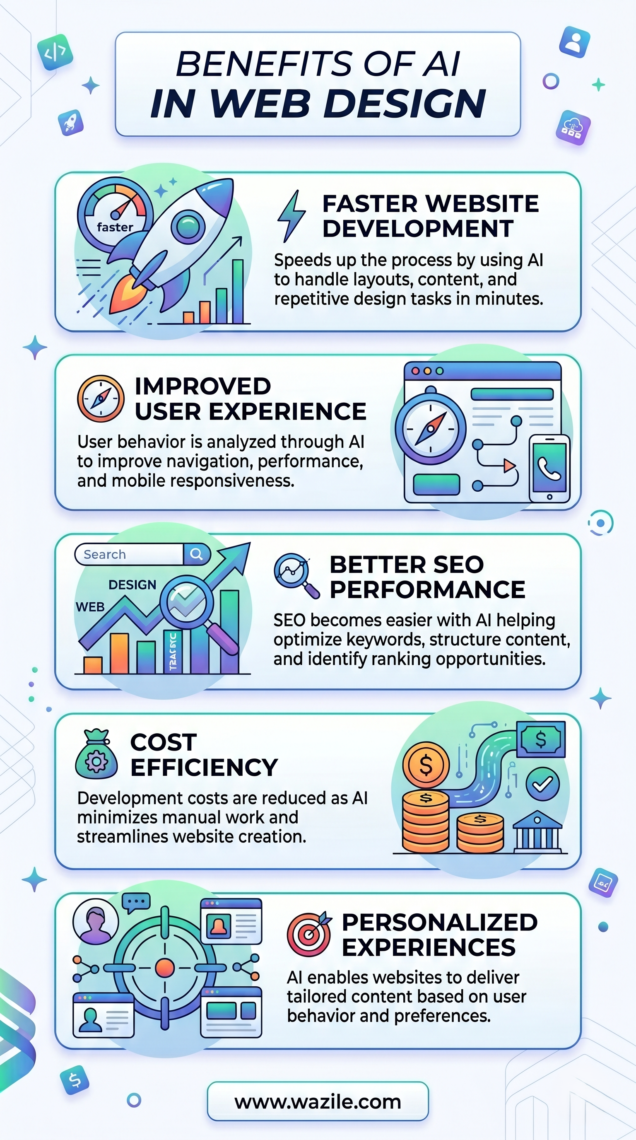
The growing adoption of artificial intelligence in digital marketing is largely driven by efficiency and automation. However, the advantages go beyond speed alone.
Here are some of the biggest Benefits of AI in Web Design.
1. Faster Website Development
AI can automate repetitive tasks that normally take hours to complete manually. Layout generation, image placement, and content suggestions can all happen within minutes.
This allows designers and developers to focus more on creativity, branding, and strategy.
2. Improved User Experience
Modern AI systems analyze how visitors interact with websites and identify areas that may need improvement.
This can include:
- Simplifying navigation
- Improving mobile responsiveness
- Adjusting call-to-action placements
- Enhancing page speed
As a result, websites become easier to use and more engaging for visitors.
3. Better SEO Performance
Many businesses are now using AI tools to strengthen their content and technical optimization strategies.
AI-powered systems can help:
- Identify ranking opportunities
- Suggest long-tail keywords
- Improve content structure
- Optimize metadata
- Analyze competitor performance
This is why many marketers are researching how AI is changing web design and search engine optimization together.
4. Cost Efficiency
AI tools can reduce production time and simplify workflows, making website creation more affordable for startups and small businesses.
While professional designers are still important, AI can assist with basic design and optimization tasks, helping teams work more efficiently.
5. Personalized Website Experiences
AI can personalize content based on user behavior and browsing history.
Examples include:
- Product recommendations
- Dynamic landing pages
- Personalized content sections
- Customized marketing messages
This level of personalization can improve conversions and customer retention.
Best AI Web Design Tools
AI-powered design tools continue to grow each year, but the best choice depends on a project’s needs, goals, and workflow. Some focus on full automation, while others support content creation, prototyping, or development tasks.
For web design and website development in the Philippines, tool selection depends on budget, project size, and the desired level of speed, customization, or control.
Here are some of the most commonly used tools today:
Wix ADI
Wix ADI uses artificial design intelligence to generate websites automatically based on user preferences. It’s beginner-friendly and ideal for small businesses that want a fast website setup.
Framer AI
Framer AI can generate website layouts and copy from simple prompts. It’s commonly used for rapid prototyping and landing page creation.
Durable
Durable is designed for entrepreneurs and freelancers who want to create professional websites quickly using automation tools.
Webflow AI
Webflow combines visual development with AI-assisted features that help streamline content creation and website management.
Hostinger AI Website Builder
Hostinger AI generates complete websites using simple prompts, making it a strong option for beginners who want an affordable all-in-one solution that includes hosting, design, and basic optimization tools.
ChatGPT and AI Writing Assistants
Many marketers and developers use AI writing tools for:
- Website copy
- Blog content
- SEO optimization
- Coding assistance
- UX content suggestions
This is why searches for the best AI tools for web design continue to increase.
AI Web Design vs. Traditional Web Design: Key Differences
| FEATURE | AI WEB DESIGN | TRADITIONAL WEB DESIGN |
|---|---|---|
| Speed | Websites can be created quickly using automation and user prompts | Can also be done efficiently with the right tools, workflow, and experienced developers |
| Customization | Limited to the platform’s tools and templates | Fully customizable based on business needs |
| Creativity | Good for simple and modern layouts | Better for unique branding and creative design |
| Cost | Usually more affordable | Can be more expensive depending on the project |
| SEO Support | Many tools include built-in SEO features | SEO is manually planned and optimized for better control |
| Ease of Use | Beginner-friendly and often no coding is needed | Requires web design or development skills |
| Flexibility | Best for simple or small business websites | Suitable for businesses of all sizes and for both simple and complex websites |
| Human Input | Relies more on automation | Relies more on designers, developers, and creative strategy |
| Best For | Quick website launches and smaller budgets | Custom websites with advanced functionality and branding for different budget sizes. |
The discussion around AI web design vs. traditional web design has become more common as automation tools become more advanced.
While AI offers convenience and speed, traditional web design still provides advantages that technology alone cannot fully replace.
Advantages of AI Web Design
AI is highly effective for:
- Automating repetitive tasks
- Speeding up website creation workflows
- Generating layouts and content quickly
- Analyzing user behavior and data
- Improving overall efficiency
This makes AI web design especially useful for small business websites, landing pages, and fast project deployments where time and cost efficiency are important.
Advantages of Traditional Web Design
Human-led design still provides strong advantages, including:
- Creative storytelling and brand identity development
- Strong visual and strategic branding direction
- Emotional connection with users
- Advanced customization and functionality
- Deeper user experience and design strategy
Experienced designers and developers understand how to build websites that align with business goals, audience behavior, and long-term digital strategy.
The Best Approach
For many businesses, the best solution is combining both methods.
AI can automate technical and repetitive processes, while human designers focus on creativity, branding, and user experience strategy.
This balanced approach helps businesses take advantage of automation without sacrificing originality.
Can AI Replace Web Designers?
A common question many people ask is: Can AI replace web designers?
No, AI cannot fully replace web designers. While AI can assist with many technical and repetitive tasks, it still lacks human creativity, strategic thinking, and emotional design understanding.
AI can assist with:
- Layout generation
- Content suggestions
- SEO improvements
- Coding support
- Data analysis
However, designers still play a major role in:
- Brand storytelling
- Emotional design
- User psychology
- Creative direction
- Business strategy
Instead of replacing designers, AI is becoming a tool that helps professionals work faster and more efficiently.
The Future of AI in Web Design
The future of web development will likely involve even deeper integration between AI and creative workflows.
Emerging trends may include:
- Smarter personalization
- Predictive user experiences
- AI-generated interfaces
- Automated accessibility improvements
- Voice-assisted website interactions
As technology continues evolving, businesses that understand the future of AI in web design may gain a stronger competitive advantage online.
At the same time, websites will still need human-centered creativity to stand out in an increasingly automated digital landscape.
Final Thoughts on AI in Web Design and Its Impact on Modern Websites
Artificial intelligence is transforming the way websites are created and managed. As more businesses adopt automation and machine learning technologies, AI-powered solutions are becoming an essential part of modern digital strategies.
Still, successful website design is not just about automation. Creativity, branding, user psychology, and strategic thinking remain critical elements of a strong online presence.
Understanding how AI works in web design allows businesses to make smarter decisions about their websites, marketing strategies, and user experiences. When used correctly, AI can improve efficiency, support SEO efforts, and help create better digital experiences without removing the value of human creativity.
Frequently Asked Questions (FAQs) About AI in Web Design
What is AI in web design?
AI in web design is the use of machine learning and automation to build, style, and optimize websites. It simplifies development by automating repetitive design tasks, layout generation, and content creation.
How does AI work in web design?
AI works by analyzing user data, search patterns, and design trends to automate website layouts and features. It uses machine learning algorithms to process metrics like bounce rates and click activity into immediate user experience improvements.
What are the benefits of AI in web design?
The main benefits are faster development speeds, lower production costs, built-in technical SEO, and automated layout personalization. It allows businesses to launch functional sites quickly while freeing up human designers to focus on complex branding.
What are the best AI web design tools?
The top AI web design platforms include Wix ADI, Framer AI, and Hostinger AI for layout generation, alongside Surfer SEO for content optimization. These tools automate early-stage wireframing and responsive coding.
Can AI build a website without coding?
Yes, AI website builders can generate fully operational, responsive websites completely without manual coding. Users simply provide basic business information via text prompts, and the system instantly outputs a structured design.
Is AI web design good for SEO?
Yes, AI enhances SEO by automatically creating mobile-responsive architectures, optimized metadata, and clean site code. When paired with tools like Semrush, it ensures technical SEO baselines are established before a site launches.
Is AI replacing web designers?
No, AI is not replacing web designers; it is an efficiency tool that handles repetitive technical work. Human professionals remain completely indispensable for brand strategy, creative storytelling, and emotional user psychology.
Start your web design project today with professional web design services in the Philippines and build a high-performing, SEO-optimized website.