


How Web Development Affects SEO (And Why It Matters for Your Website)


Most people think search engine optimization (SEO) is all about keywords, blog posts, and backlinks. And sure, those matter. But here’s the part many overlook: your website’s development plays a huge role in how well you rank on Google.
You could have the best content in your industry, but if your website is slow, messy, or hard for search engines to understand, you’re basically invisible online.
Let’s break it down in a clear and practical way so you can use this information to improve your site.
Key Takeaways: How Web Development Affects SEO
| • Website Speed: Faster page loading improves user interaction and is a key signal for search performance. • Site Structure: A well-organized layout with clean URLs makes content easy for search engines to find and understand. • Mobile-Friendly Design: Responsive design ensures a site works across all devices, which is essential for modern search visibility. • Code Quality: Clean, error-free code allows search engines to crawl and index pages more efficiently. • Technical Optimization: Fixing broken links and missing metadata prevents development errors from hurting your search rankings. |
Table of Contents
- The Connection Between Web Development and SEO
- How Website Speed Impacts Search Rankings
- Structuring Your Website for Better AI Understanding
- Why Mobile-Friendly Design Is Essential
- User Experience Signals That Affect SEO
- The Role of Clean Code in Search Visibility
- Common Development Issues That Can Hurt Rankings
- Building a Website That Supports Long-Term SEO
- Final Thoughts on Web Development and SEO
- Frequently Asked Questions (FAQ)
The Connection Between Web Development and SEO
Your website is like a digital storefront. SEO attracts visitors, but how your site is built determines whether they stick around, explore, or leave right away.
Search engines evaluate things like:
- Page speed
- Mobile responsiveness
- Website structure
- Code quality
All of these directly influence rankings. That’s why understanding best web development practices for better SEO rankings is key—not just for developers, but for business owners too.
How Website Speed Impacts Search Rankings
Let’s be real—no one likes a slow website.
If your page takes too long to load, users leave. And when that happens often, search engines take it as a sign that your site isn’t providing a good experience.
That’s exactly why website speed matters for SEO performance.
Slow websites often lead to:
- Higher bounce rates
- Lower engagement
- Missed conversions
Meanwhile, faster sites tend to:
- Keep visitors longer
- Improve user interaction
- Perform better in search results
Simple Ways to Improve Site Speed
If you want better website speed and SEO optimization, start with these:
- Compress large images
- Enable browser caching
- Reduce unnecessary scripts
- Use reliable hosting
- Clean up bulky code
Even small tweaks can lead to noticeable improvements.
Related: Optimizing Images for Faster Website Loading: A Guide to Speed Up Your Site
Structuring Your Website for Better AI Understanding
A well-organized site helps both users and search engines navigate your content with ease.
If you’re figuring out how to optimize your website structure for SEO, the goal is simple: make everything easy to find and understand.
Key Elements of a Strong Site Structure
- Clear Navigation
Keep your menu simple and intuitive so users can find what they need quickly—without feeling overwhelmed.
- Clean URLs
Use short, descriptive URLs that reflect the page content and are easy to understand.
- Proper Headings
Organize content with H1, H2, and H3 tags to improve readability and structure.
- Internal Linking
Link related pages to guide users and improve navigation. Use natural anchor texts that clearly describe the content to help both users and search engines understand your site better.
Connect related pages using helpful anchor texts like:
- tips for improving website structure
- best web development strategies for higher rankings
This improves both user experience and crawlability.
Why Mobile-Friendly Design Is Essential
More users browse on their phones than ever before. If your website doesn’t adapt to different screen sizes, you’re losing both traffic and rankings. Responsive design ensures your site looks and works well across all devices.
Focus on:
- Flexible layouts
- Fast mobile loading speeds
- Clickable buttons
- Easy-to-read text
Keep in mind that search engines prioritize mobile-friendly sites, so this isn’t optional anymore.
User Experience Signals That Affect SEO
User experience (UX) plays a bigger role in rankings than many realize.
When visitors stay longer, explore more pages, and interact with your content, it sends positive signals to search engines.
Good UX includes:
- Fast-loading pages
- Clear layout and navigation
- Readable content
- Minimal distractions
These elements work together to improve both engagement and visibility.
The Role of Clean Code in Search Visibility
Behind every great website is clean, efficient code.
Search engines rely on this structure to crawl and index your pages properly. If your code is cluttered or outdated, it can slow everything down.
Following best web development practices for better SEO rankings means keeping your code:
- Organized and lightweight
- Free from errors
- Optimized for performance
This helps search engines process your site more efficiently.
Common Development Issues That Can Hurt Rankings
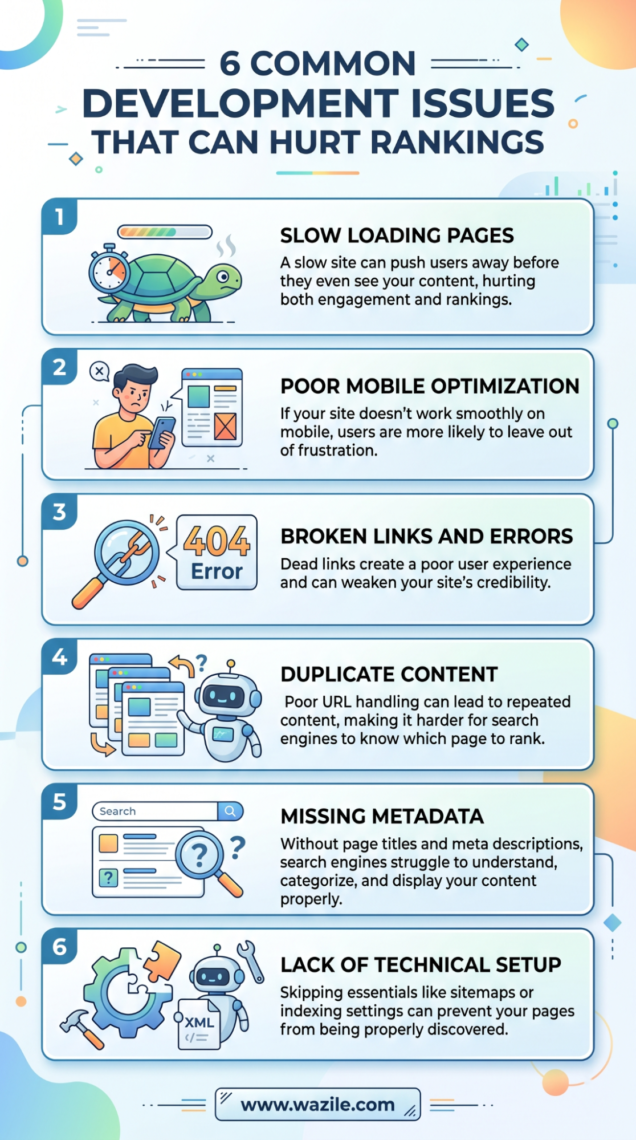
Even visually appealing websites can struggle if certain technical issues are present. Here are some common web development mistakes that hurt SEO:
1. Slow Loading Pages
A slow site can push users away before they even see your content, hurting both engagement and rankings.
2. Poor Mobile Optimization
If your site doesn’t work smoothly on mobile, users are more likely to leave out of frustration.
3. Broken Links and Errors
Dead links create a poor user experience and can weaken your site’s credibility.
4. Duplicate Content
Poor URL handling can lead to repeated content, making it harder for search engines to know which page to rank.
5. Missing Metadata
Metadata includes elements like page titles and meta descriptions that provide search engines with information about your content. Without them, search engines may struggle to understand, categorize, and display your pages correctly in search results.
6. Lack of Technical Setup
Skipping essentials like sitemaps or indexing settings can prevent your pages from being properly discovered.
Building a Website That Supports Long-Term SEO
Your website should grow with your business—not hold it back.
Smart development choices today can:
- Make future updates easier
- Support better performance
- Strengthen your SEO foundation
A well-built site makes it easier to implement strategies like:
- Content optimization
- Speed improvements
- Technical enhancements
That’s why investing in best web development practices for better SEO rankings early on is worth it.
Final Thoughts on Web Development and SEO
Search engine visibility isn’t just about creating content—it also depends on how your website is built. From page speed and site structure to mobile responsiveness and clean code, every detail affects how your site performs in search results.
Focusing on website speed and optimization, improving your site structure, and fixing common web development mistakes can make your site faster, easier to navigate, and more visible online. In the end, when web development and optimization work together, your website not only ranks better but also provides a smoother and more enjoyable experience for your visitors.
Frequently Asked Questions (FAQ)
1. Does web development affect SEO?
Yes. Web development directly affects SEO because it controls how fast your website loads, how easily search engines can crawl your pages, and how well users can navigate your site. Poor development can lower rankings even if your content is strong.
2. What is the most important web development factor for SEO?
While many factors contribute, page speed (Core Web Vitals) is currently considered the most critical development factor. A fast-loading site reduces bounce rates and is a confirmed Google ranking signal.
However, speed must be supported by mobile responsiveness and clean crawlable code to ensure long-term visibility.
3. Can good SEO work without good web development?
Not effectively. Even with strong keywords and content, a poorly built website can struggle to rank due to slow speed, broken structure, or indexing issues. SEO and web development must work together.
4. Why is mobile optimization important for SEO?
Mobile optimization is important because Google uses mobile-first indexing. This means Google evaluates the mobile version of your website first when deciding rankings.
Build your online presence with professional web design services in the Philippines for your business and boost your visibility with expert SEO services in the Philippines because your business deserves to be seen. Contact us to get started today and take the first step toward a stronger online presence.