

Social Media vs Websites: What Should SMEs Prioritize in 2026?

For many small and medium enterprises, building an online presence still feels like a constant juggling act. One day, everyone says you must be active on social media. Next, you hear that having a website is essential for any serious business. So the big question remains: which digital platform should SMEs focus on in 2026?
If you’re running a small business with limited time, budget, and manpower, this decision matters. You don’t want to spread yourself too thin, but you also don’t want to miss out on customers. Let’s break things down in a practical, no-fluff way and figure out what actually makes sense this year.
Table of Contents
- The Role of Social Media for SMEs Today
- Why Websites Matter for SMEs
- Website vs Social Media Pros and Cons for SMEs
- Should SMEs Focus on Social Media or Websites First?
- Why SMEs Should Use Both Social Media and Websites
- A Practical Digital Marketing Strategy for SMEs
- Final Thoughts: What Should SMEs Prioritize in 2026?
The Role of Social Media for SMEs Today
Why Social Media Still Feels Like the Obvious Choice
Social platforms are attractive to small businesses for one simple reason: they’re easy to start. Creating a Facebook page or Instagram account is free, and you can begin posting content almost immediately.
This is why social media marketing for small businesses remains popular:
- Low barrier to entry
- Fast visibility and engagement
- Direct interaction with customers
- Great for storytelling and brand personality
If your audience is active online, social media helps you stay visible and relevant.
Where Social Media Really Shines
Social media works best when your goal is:
- Building awareness
- Creating a community
- Engaging customers regularly
- Promoting offers, events, or new products
For many SMEs, social platforms act as their digital storefront. People discover your brand through a post, a reel, or a shared story before they even think about buying.
The Limitations SMEs Often Ignore
While social media is powerful, it’s not perfect. Relying on it alone can be risky.
Some common challenges include:
- Algorithm changes that limit reach
- Content fatigue (you must post constantly)
- Limited control over your platform
- Difficulty ranking on search engines
This leads to an important question many business owners ask: is social media enough for small businesses? In most cases, the answer is no, especially if long-term growth is your goal.
Why Websites Matter for SMEs
Do Small Businesses Still Need a Website?
Short answer: yes. Long answer: yes, and more than ever.
Despite the rise of social platforms, people still expect legitimate businesses to have a website. When customers search your brand name on Google, your site is often the first thing they look for.
So if you’re wondering if small businesses still need a website, the answer is clear, especially if you want credibility, visibility, and control.
Related: 5 Benefits of Having a Website for Your Small Business
What a Website Does That Social Media Can’t
A website gives SMEs something social media never fully can: ownership.
With a website, you can:
- Control your branding and messaging
- Rank on Google through SEO
- Capture leads and inquiries
- Showcase products, services, and testimonials
- Build trust with long-form content
This is why the website’s importance for SMEs continues to grow, even in a social-first world.
Websites and Search Intent
Unlike social media, websites target users who are actively searching. When someone Googles your service, they’re often closer to making a decision.
That makes your website a key player in your digital marketing strategy for SMEs, especially for:
- Service-based businesses
- B2B companies
- Local SMEs targeting nearby customers
Website vs Social Media Pros and Cons for SMEs
To make things clearer, let’s compare both sides honestly.
Pros of Social Media
- Quick setup and low cost
- High engagement potential
- Ideal for brand awareness
- Easy customer communication
Cons of Social Media
- You don’t own the platform
- Organic reach can disappear overnight
- Requires constant content creation
- Limited SEO value
Pros of Websites
- Full control over content and design
- Strong SEO and search visibility
- Professional credibility
- Better conversion opportunities
Cons of Websites
- Requires upfront investment
- Needs maintenance and updates
- Slower results compared to viral social posts
Should SMEs Focus on Social Media or Websites First?
This is where strategy matters.
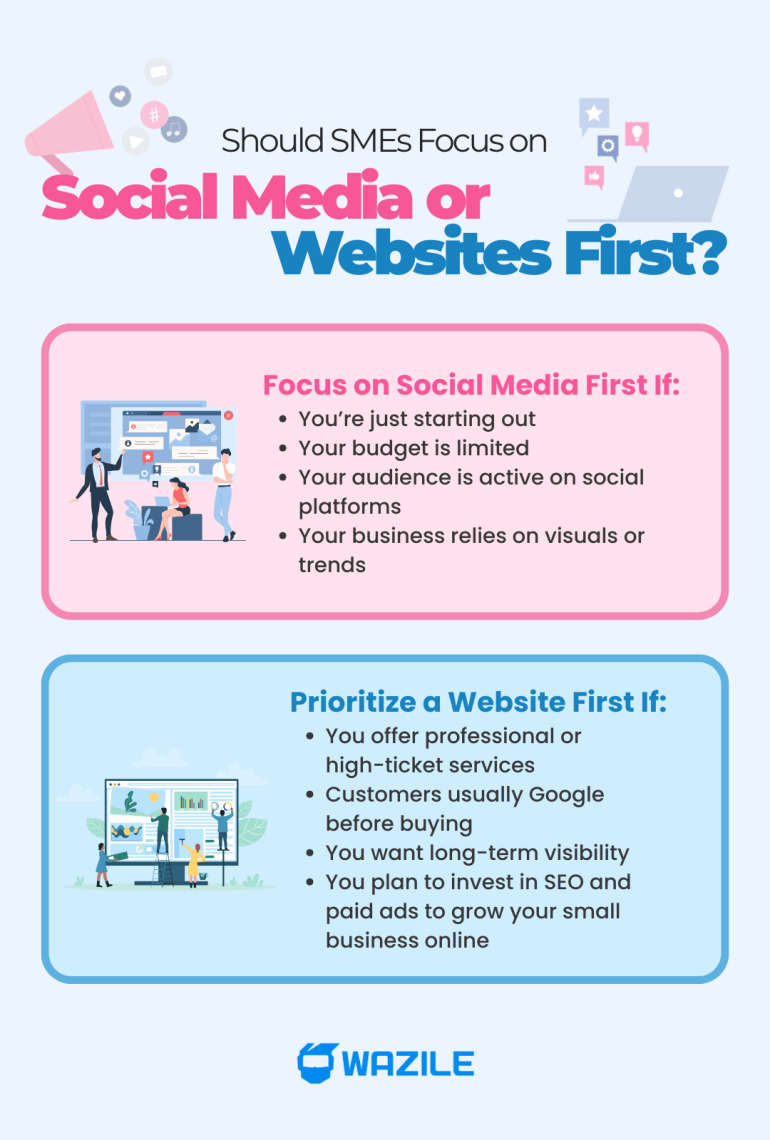
When Social Media Should Be the Priority
You might focus on social media first if:
- You’re just starting out
- Your budget is very limited
- Your audience is highly active on social platforms
- Your business relies heavily on visuals or trends
In this case, social media helps you build momentum fast.
When a Website Should Come First
You should prioritize a website if:
- You offer professional or high-ticket services
- Customers usually Google before buying
- You want long-term visibility
- You plan to invest in SEO and paid ads to grow your small business online.
For many business owners asking should SMEs focus on social media or websites, the answer depends on how quickly you want results versus how sustainable you want growth to be.
Related: Which One Should Go First? Website or Social Media Marketing?
Why SMEs Should Use Both Social Media and Websites
Here’s the truth: the smartest businesses today don’t choose one over the other.
Instead of debating which platform is better, the real focus should be on how to make both work in harmony.
A simple but effective approach looks like this:
- Use social media to build awareness and engage your audience.
- Let your website establish trust and convert visitors into customers.
Social media posts can direct people to your site, while your website can showcase customer reviews, testimonials, and even social media feeds. Together, this creates a stronger, more complete online presence.
A Practical Digital Marketing Strategy for SMEs
If you’re building a sustainable digital marketing strategy for SMEs, here’s a realistic approach:
- Start with a basic but solid website: Focus on clarity, mobile-friendliness, and essential pages.
- Choose one or two social platforms: Go where your audience already spends time.
- Use content with purpose: Social media for reach, website content for depth.
- Track what actually converts: Likes are nice, but leads and sales matter more.
- Improve gradually: You don’t need everything at once. Build step by step.
Final Thoughts: What Should SMEs Prioritize in 2026?
So, back to the big question: social media vs websites—what should SMEs prioritize in 2026?
Social media is excellent for visibility and connection. Websites remain essential for trust, search visibility, and conversions. One without the other limits your growth.
If you’re serious about scaling, the goal isn’t choosing between platforms—it’s using both wisely. A balanced approach gives SMEs the flexibility to adapt, grow, and stay competitive in a fast-changing digital landscape.
In 2026, the businesses that win are the ones that build visibility and credibility at the same time.
Looking to grow your business online? Get expert social media marketing services for small businesses in the Philippines paired with custom website design services that actually convert.